
Mobile Offices vs. Traditional Building Construction: Which is Right for You?


When a business outgrows its existing workspace, people often start to think unnecessarily big: new construction, expanded square footage, and a permanent footprint. But that instinct doesn’t always yield the most practical or cost-effective decision. For many organizations, containerized mobile offices can provide the same functional workspace at a fraction of the time and cost, without logistical complexities.
This article breaks down the key differences between mobile offices, which are typically built from modified shipping containers, and traditional building construction. Whether you’re managing a construction site, running a manufacturing facility, or scaling a logistics operation, understanding these distinctions can help you make an informed choice that aligns with your business’s goals and budget.
What is a Mobile Office?
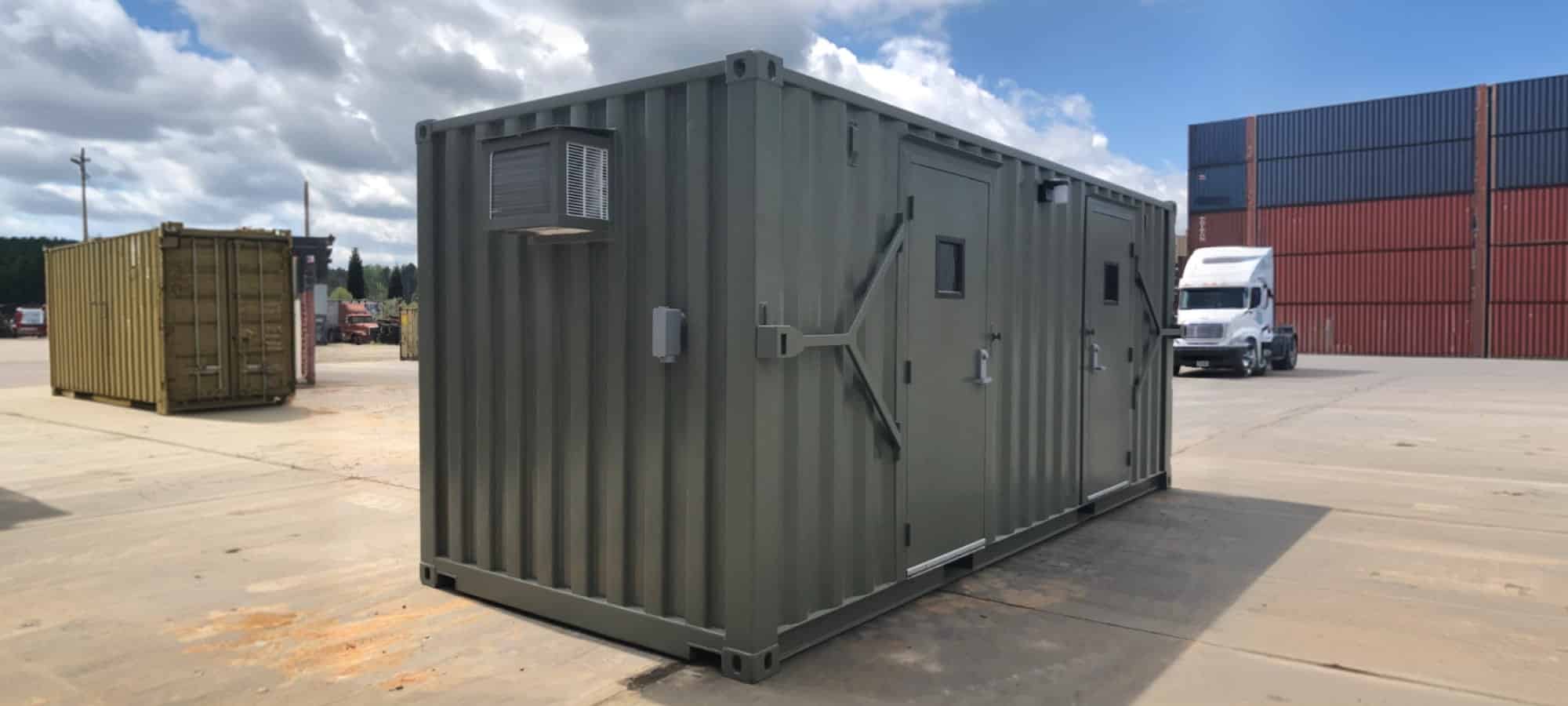
A mobile office is a repurposed or purpose-built shipping container that has been modified to function as a professional workspace. These units are made from the same heavy-duty, corrosion-resistant steel used in international freight containers, making them inherently durable and weather-resistant.
Standard shipping containers are available in lengths of 10, 20, and 40 feet, while high-cube models offer an additional foot of interior height. With the right modifications, these units can be transformed into fully functional offices equipped with:
- Electrical wiring and lighting
- HVAC systems for climate control
- Insulation for thermal and acoustic comfort
- Windows, skylights, and customized entry doors
- Interior finishing, such as drywall & flooring
As a result, the workspace doesn’t feel like an industrial container. Instead, it feels professional, comfortable, and uniquely tailored to a business’s needs.
The Case for Mobile Offices
Speed of Deployment
One of the most immediate advantages of a mobile office is how quickly a business can acquire one and set it up. Traditional construction projects, even modest ones, require design, permitting, materials procurement, and labor coordination. The process can stretch from several months to over a year, depending on the project’s scope and local regulatory requirements.
By contrast, container-based offices can often be delivered and ready for use within a few weeks. For businesses that need extra workspace quickly to accommodate growth, a new job site, or a temporary facility need, this speed can be the difference between maintaining momentum and losing it.
Lower Upfront Investment
Building construction comes with a price tag. Commercial construction in the Atlanta metropolitan area, like most urban markets, is priced per square foot and rises quickly when factoring in materials, skilled labor, project management, and finishing work. Beyond direct construction costs, businesses must also budget for:
- Architectural and engineering services
- Permitting and inspection fees
- Utility connections and infrastructure upgrades
- Landscaping and site preparation
- Increased property taxes once construction is complete
A containerized mobile office avoids much of this financial burden. The unit itself accounts for the main investment, with modifications and site preparation adding incrementally rather than exponentially. For businesses that need to manage capital carefully, especially smaller companies or those in a growth phase, this reduced financial exposure offers a meaningful advantage.
Flexibility and Portability
Perhaps the defining characteristic of a mobile office is its flexibility. Because shipping containers are designed for transport by truck, rail, or ship, businesses can relocate them relatively easily. A construction company that finishes one job site and moves to another doesn’t need to abandon its office infrastructure; instead, the container moves with the crew.
This portability also has strategic implications. A business expanding to a new region can deploy temporary office space without committing to a lease or construction project. If the expansion succeeds, they can make more permanent arrangements accordingly. If not, a business can relocate or repurpose the container without significant financial loss.
Modular scalability is another benefit worth highlighting. If workspace needs grow, additional containers can be added to a site and even interconnected to create larger spaces. This kind of incremental expansion isn’t possible with traditional construction, where scaling up means starting an entirely new building project.
Durability Built for the Outdoors
Shipping containers were originally engineered to protect cargo during extreme conditions: oceanic voyages, stacking under heavy loads, and exposure to salt air, rain, and heat. This history translates directly into durability for use on land.
A well-maintained container office can remain in service for 20 years or more. The steel construction resists pests, mold, and structural deterioration that can affect wood-framed buildings over time. Routine maintenance, such as inspecting door seals and addressing surface rust, keeps units in excellent condition without the ongoing expense of traditional building upkeep.
Minimal Site Preparation
Most container offices require only a level surface for placement. Common base options include compacted gravel, concrete pads, asphalt, or railroad ties. This simplicity starkly contrasts traditional construction, which often demands extensive site work, including grading, foundation pours, and utility trenching.
For businesses operating on leased land, the ability to deploy a workspace without altering the underlying property is often essential. When the time comes to vacate, businesses can easily remove their containers without leaving a permanent footprint behind.
The Case for Traditional Building Construction
Mobile offices are a compelling solution in many scenarios, but they aren’t the right answer for every business. Traditional construction offers its own distinct advantages that storage containers can’t achieve.
Permanence and Integration
A permanent building is, by definition, fixed, and for many organizations, that’s exactly what’s needed. A facility can be designed from the ground up to integrate seamlessly with existing infrastructure, accommodate complex workflows, and meet specialized requirements that go beyond what a modified container can offer.
Industries with highly specific environmental requirements, such as pharmaceutical manufacturing, food processing, or advanced research, often need facilities that exceed the customization possibilities of containerized offices. In these cases, new construction is the more appropriate choice.
Long-Term Value and Ownership
A permanent building is a real estate asset. It contributes to property value, can be leveraged for financing, and may appreciate over time, depending on the market. For organizations with stable, long-term space needs and the budget for a significant investment, construction can provide a sound long-term strategy.
However, this changes when businesses factor in the full lifecycle cost of a building, including maintenance, insurance, property taxes, and the cost of capital tied up in the investment. Mobile offices, which require less upfront capital, allow businesses to deploy resources toward equipment, staffing, or market expansion. Mobile offices also retain their value over time, allowing businesses to resell if unneeded or repurposing.
Regulatory and Aesthetic Considerations
In some jurisdictions and commercial environments, a permanent building is the expected standard. Certain zoning requirements, commercial real estate norms, or client-facing considerations may make traditional construction the more appropriate choice. A business hosting clients or operating in a high-visibility location may prioritize the professional appearance of a purpose-built facility.
It’s also worth noting that permitting requirements for container-based offices vary by municipality. While this process is generally simpler than full construction permitting, businesses should consult local authorities before deployment to ensure compliance.
Side-by-Side Comparison: Key Factors
When evaluating which option is right for your organization, the following factors are worth examining closely.
- Timeline: Businesses can typically deploy mobile offices within weeks. Traditional construction projects rarely take less than several months, and complex projects can extend well beyond a year.
- Cost: Container-based offices require significantly lower upfront investment. Traditional construction involves not only direct building costs but a range of soft costs, like architectural fees, permits, and utility connections that can substantially increase total cost.
- Flexibility: Mobile offices can be relocated, reconfigured, or repurposed. Traditional buildings are permanent by design, and expanding or altering them requires initiating new construction processes.
- Maintenance: Both options require ongoing maintenance, but the scope differs. Container offices benefit from straightforward steel construction that resists many common forms of building deterioration. Traditional buildings involve more complex systems that require regular servicing and eventual replacement, including HVAC, roofing, and electrical.
- Resale Value: Shipping containers retain reasonable resale value and can be sold if workspace needs change. A permanent building is not easily liquidated and may sit vacant or underutilized if business conditions shift.
Choosing the Right Solution for Your Business
The decision between a mobile office and traditional construction ultimately depends on four factors: how quickly you need the space, how long you’ll need it, how much capital you’re prepared to invest, and how likely your needs are to change.
Mobile offices tend to be the right fit when:
- You need an operational workspace quickly, without waiting for a construction cycle
- Your workspace needs are likely to evolve over time
- You operate across multiple job sites or locations
- You want to preserve capital for other business priorities
- You need a professional workspace without a long-term real estate commitment
Traditional construction is typically the better choice when:
- Your space needs are stable and well-defined for the long term
- You require highly specialized environmental or infrastructure conditions
- You’re building a permanent facility that will function as a real estate asset
- Your business’s professional image requires a purpose-built facility
- You have the financial resources and timeline to support a full construction project
Many businesses find that the two options aren’t mutually exclusive. A company might use container-based mobile offices to address immediate space needs while a permanent facility is planned and constructed, getting the best of both approaches without sacrificing operational continuity.
Find Container Storage for Your Business
For businesses across Atlanta and the surrounding region, the choice between a mobile office and traditional construction is rarely clear-cut. Both options have legitimate advantages, and the right answer depends on the specific operational, financial, and logistical context of your organization.
Containerized mobile offices Atlanta businesses deploy have evolved well beyond their industrial origins. Today’s modified shipping containers can offer professional, comfortable, and fully functional workspaces that deploy quickly, adapt to changing needs, and deliver strong value over time.
Container Technology has been serving businesses across the Atlanta metropolitan area since 1988, offering a wide range of new and used Atlanta shipping containers for sale along with extensive customization options. Whether you need a basic on-site office or a fully modified workspace with climate control, lighting, and interior finishing, our team can help you identify the right solution for your needs. Request a free quote online or call us today to get started.
GET A FREE QUOTE NOW CALL TODAY
Frequently Asked Questions
How long does it take to set up a mobile office from a shipping container?
In many cases, a standard container can be delivered to your site within a few weeks. If modifications such as electrical wiring, HVAC, insulation, or interior finishing are required, the timeline extends depending on the scope of work. Even with substantial modifications, container offices are typically ready for occupancy far sooner than a traditional construction project, often within weeks rather than months.
Do I need a permit to place a container office on my property in the Atlanta area?
Permit requirements vary depending on your municipality, zoning district, and how your business will use the container. Temporary placements on commercial or industrial property often face fewer regulatory hurdles than permanent installations. It’s always advisable to check with your local zoning office or a knowledgeable supplier before placement to ensure your plans are compliant with local regulations.
Can a container office be connected to utilities like electricity, water, and internet?
Yes. Shipping containers can be modified to accommodate full utility connections, including electrical wiring, lighting, HVAC systems, plumbing, and telecommunications infrastructure. The extent of these modifications depends on your operational needs and site conditions. Many businesses opt for electrical and climate control as a baseline, with additional systems added as required.
How does the cost of a modified container office compare to leasing commercial office space?
The cost comparison depends heavily on your market, lease terms, and how long you need the space. In many cases, purchasing and modifying a container represents a lower total cost over a two-to-five-year horizon than leasing equivalent commercial square footage, particularly when factoring in the container’s resale value. For businesses with shorter-term needs or those in high-rent markets, the savings can be even more pronounced.
What modifications are most commonly made to container offices?
The most popular modifications for office use include electrical wiring and lighting, HVAC installation for climate control, insulation for thermal comfort and noise reduction, windows and skylights for natural light, roll-up or standard entry doors, and interior finishing such as drywall, flooring, and cabinetry. Security enhancements, including heavy-duty locking mechanisms and lock boxes, are also commonly added for sites with valuable equipment or sensitive documents.
Can multiple container offices be combined to create a larger workspace?
Yes. One of the significant advantages of containerized offices is their modularity. Multiple containers can be placed side by side or end to end and interconnected through custom openings to create larger, multi-room workspace configurations. This scalability allows businesses to expand their office footprint incrementally without committing to an entirely new construction project, which offers a meaningful advantage for organizations whose space needs will likely fluctuate over time.