
Shipping Container Sizes Explained for Lawrenceville Businesses: Which Container Fits Your Operation?


Lawrenceville has grown into one of Gwinnett County’s most bustling business hubs, with contractors, distributors, retailers, and manufacturers all competing for space near Highway 316 and the I-85 corridor. As local operations expand, one question arises time and time again: what shipping container size actually fits the job? The answer isn’t always obvious, and picking the wrong size can mean paying for space you don’t need or running out of room within a few months.
This guide breaks down the most common container sizes available to Lawrenceville businesses, the best use cases for each size, and how to think through the decision based on your industry, site layout, and budget. Whether you’re browsing shipping containers that Lawrenceville contractors rely on for job-site storage or comparing 20-ft shipping containers that Lawrenceville retailers use for inventory overflow, this breakdown will make the decision easier and more straightforward.
Looking for Lawrenceville shipping containers for your business? Contact Container Technology now for a free quote.
Why Does Container Size Matter So Much?
Once you decide that containerized storage is the ideal route for your business, it’s tempting to just jump on whatever size is cheapest or most easily available. However, in practice, container size drives nearly every other decision that follows: where the unit can be placed on your property, how much it costs to deliver, what modifications make sense, and how much flexibility you’ll have if your storage needs change down the road.
An overly small container forces you to either rent a second unit sooner than planned or cram inventory into a space that wasn’t designed for it, creating safety hazards and slowing down day-to-day operations. A container that’s too large, on the other hand, sits mostly empty and takes up valuable yard space that could be used for parking, staging, or future expansion. Getting the size right the first time saves money and headaches later.
Breaking Down the Standard Sizes
Shipping containers come in a handful of standardized dimensions, a byproduct of their original design for international freight transport. The standardization works in your favor as a buyer, since it means pricing, availability, and specifications are predictable and easy to compare across sizes.
10ft Containers: A Compact Option for Tight Spaces
As the smallest commonly available option, 10′ containers are a good fit for businesses with limited outdoor space or relatively modest storage requirements. Small retail operations, home service businesses, and companies that just need a place to secure tools, seasonal equipment, or records often gravitate toward this size. Because of its smaller footprint, a 10-foot unit can often be squeezed into corners of a property where a larger container wouldn’t fit, including narrow side yards or spaces near existing buildings.
20ft Containers: The Common Middle Ground
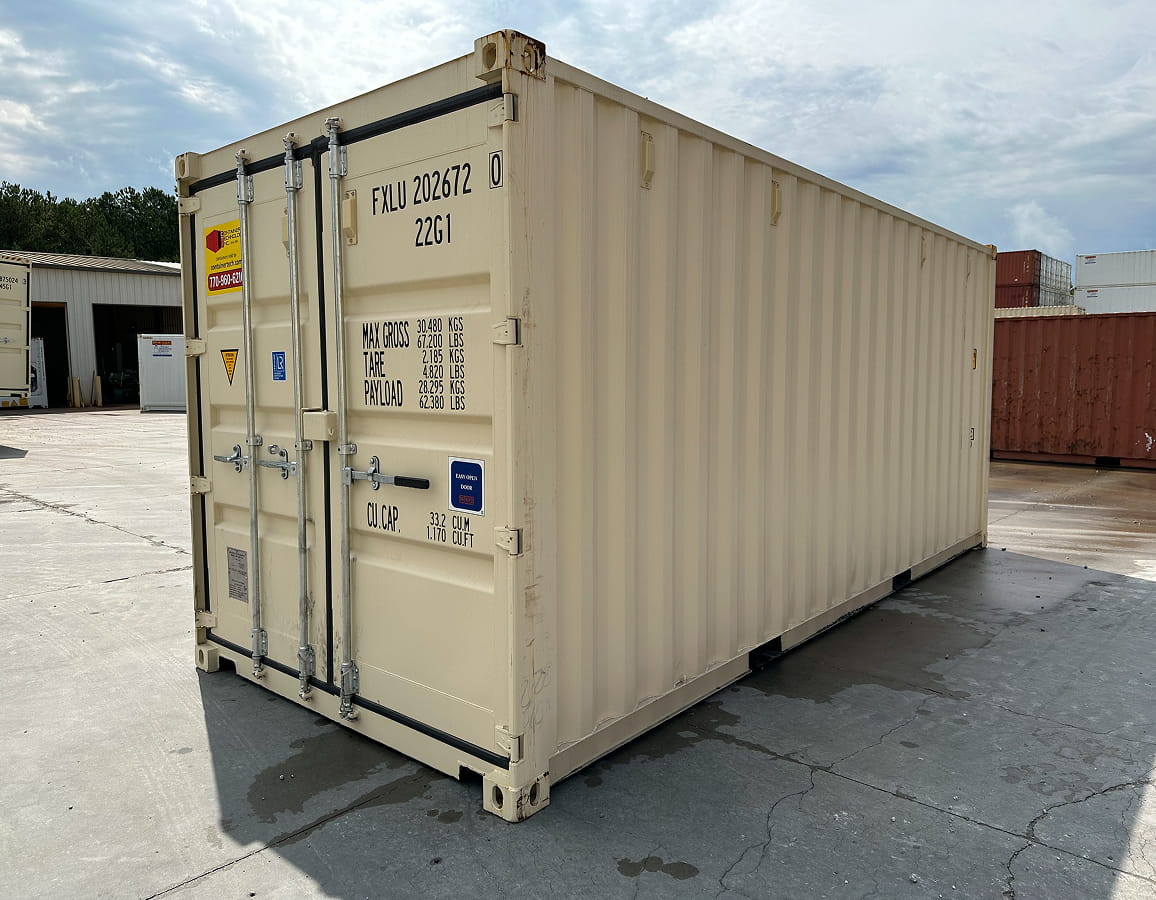
For a large share of Lawrenceville businesses, 20′ shipping containers provide the ideal sweet spot between capacity and footprint. These units offer roughly double the interior volume of a 10-foot container while still remaining manageable in terms of site placement, delivery logistics, and cost.
A 20ft container typically provides around 1,170 cubic feet of storage space, enough to hold a substantial amount of palletized inventory, construction materials, or equipment without taking up a large section of your property. This size is particularly popular among general contractors who need secure, on-site storage for tools and materials, retailers managing overflow inventory during busy seasons, and small manufacturers storing raw materials or finished goods close to the production line.
Because 20ft containers are among the most widely available sizes, businesses often have more flexibility when it comes to choosing between new, one-trip, and used units at various price points. That availability also tends to translate into faster delivery timelines compared to less common sizes.
40ft Containers: Built for Volume
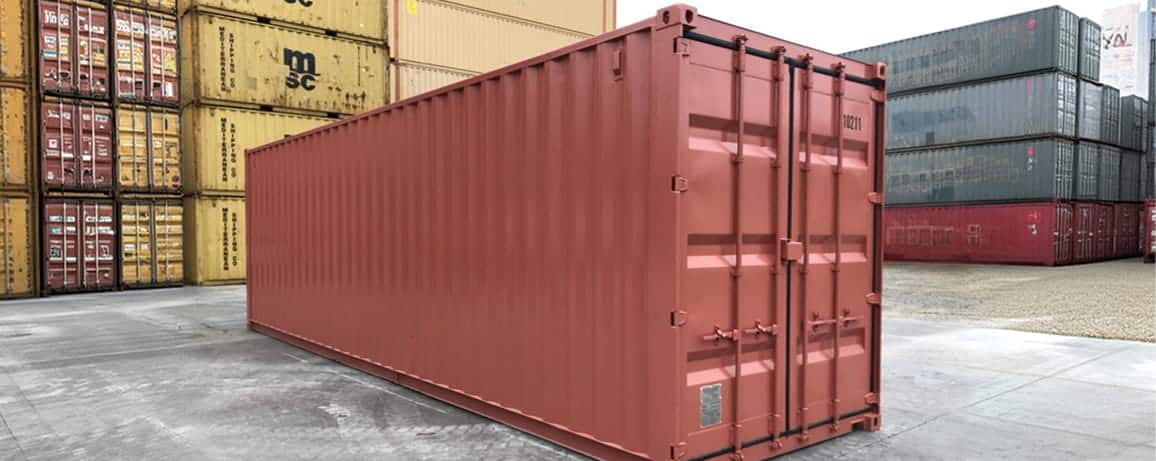
When storage needs are maximized, 40’ shipping containers become the more practical choice for Lawrenceville businesses. These units roughly double the capacity of a 20ft container, offering around 2,350 cubic feet of interior space. That extra room makes a meaningful difference for companies handling bulk goods, large equipment, or high-volume palletized inventory.
Distribution centers, larger construction firms managing multiple active job sites, and manufacturers with substantial raw material or finished product volumes are common users of 40-foot containers. Logistics companies also favor this size because it integrates seamlessly with existing freight and shipping infrastructure, making it easier to stage outbound shipments or temporarily hold goods in transit.
The tradeoff with these units, naturally, is footprint. A 40ft container requires considerably more level ground than smaller options, so site planning becomes a higher priority. Businesses with limited yard space may need to think carefully about placement, access for delivery trucks, and how the container’s location will affect existing traffic patterns on the property.
High Cube Containers: Extra Height for Specialized Needs
For businesses that need vertical clearance in addition to floor space, high cube containers offer an additional foot of height compared to standard units, typically standing at 9’6″ rather than the standard 8’6″. This extra headroom is valuable for storing tall equipment, stacking inventory on shelving systems, or converting a container into a functional workspace where standing clearance matters. High cube units are available in 40’ and larger configurations, providing a practical option for businesses that need both volume and height.
Matching Container Size to Your Industry
Different industries around Lawrenceville tend to gravitate toward different sizes based on the nature of their work, and understanding those patterns can help narrow down the decision quickly.
Contractors and construction firms often start with a 20-foot container for a single active job site, since it’s large enough to secure power tools, smaller equipment, and building materials without dominating the site. Firms juggling multiple job sites or larger commercial projects frequently move up to 40-foot units, sometimes deploying more than one across different locations.
Retailers dealing with seasonal inventory swings, holiday merchandise, or promotional stock tend to favor 20-foot containers for their balance of capacity and ease of placement near existing store locations. Warehouses and distribution operations facing overflow situations, where the primary facility has simply run out of room, more commonly reach for 40-foot units, since the goal is usually to offload as much volume as possible into a single, easily accessible unit.
Manufacturers vary depending on their production volume. Smaller operations or businesses storing components rather than finished goods often fare well with 20-foot containers, while larger manufacturers moving significant quantities of raw materials or shipping palletized finished products tend to need the extra capacity of a 40-foot unit, sometimes paired with high-cube configurations for stacked storage.
Site Considerations: Placement and Accessibility
Choosing the right size isn’t only about how much you need to store. It also depends on where the container will go and how it fits into daily operations.
Smaller containers, including 10’ and 20’ units, tend to be easier to place in tight or irregular spaces, such as along perimeter fencing, in gaps between existing structures, or in areas with limited turning radius for delivery trucks. They’re also simpler to relocate later if your site layout changes or if you decide to move the container to a different property.
40’ containers require more planning. Delivery trucks need adequate clearance to maneuver into position, and the surrounding ground should be level and stable enough to support the unit’s weight without settling unevenly over time. Businesses considering a 40’ container should consider their property beforehand to confirm there’s a suitable, accessible location, ideally one that doesn’t interfere with parking, loading docks, or existing traffic flow.
For companies that need more space than a single unit but don’t want to commit to a larger footprint all at once, combining multiple containers is often a practical path. Two 20’ units placed side by side, for example, can offer flexibility that a single 40’ container doesn’t, since each unit can be relocated or removed independently if storage needs shift.
Weighing Cost Against Capacity
Price is naturally part of the size decision, and container pricing generally scales with size, though not always in a strictly linear way. A 20ft container costs less upfront than a 40ft unit, but businesses that end up needing two 20ft containers to match the capacity of a single 40ft unit may find that the larger option delivers better value per square foot of storage, along with lower combined delivery costs.
Condition also factors into the equation at every size. Used containers offer a more budget-friendly entry point and are often perfectly adequate for standard storage purposes, while new or one-trip units come at a premium but offer a cleaner appearance and longer expected service life. This can matter for businesses using containers in customer-facing applications or planning to keep the unit in service for decades.
Modifications add another layer to the cost conversation regardless of size. Businesses often invest in shelving systems, lighting, insulation, HVAC, or upgraded locking mechanisms to tailor a container to their specific requirements, and these additions can influence which base size makes the most financial sense.
Making the Right Call for Your Business
There’s no universal answer to which container size is best. The right choice depends on how much you’re storing today, how much room you expect to need in the coming years, and how much space you can realistically dedicate to storage on your property. Businesses that are uncertain often benefit from starting with a 20-foot container, given its balance of capacity, cost, and ease of placement, then scaling up to a 40-foot unit or adding a second container once actual usage patterns become clear.
For companies with predictable, high-volume storage needs from the outset, whether that’s a distribution center managing constant inbound and outbound freight or a construction firm running several large projects simultaneously, jumping straight to a 40-foot container often makes more sense than starting small and outgrowing the space within a matter of months.
Container Technology has served businesses throughout the greater Atlanta area, including Lawrenceville, for more than 35 years, helping companies of every size match their storage needs to the right container solution. Our team can walk through your site, your industry’s typical requirements, and your budget to help you land on the size that actually works, not just the one that sounds right on paper. Request a free quote online or call us today to talk through your options.
Frequently Asked Questions
What shipping container sizes are available?
Shipping containers are commonly available in 10’, 20’, and 40’ lengths, with high-cube versions offering an additional foot of height in 40’ and larger configurations. Each size serves different storage needs, from compact tool storage to large-scale inventory and equipment management.
Which industries in Lawrenceville use 20ft containers?
20ft containers are popular among general contractors, retailers managing seasonal or overflow inventory, and smaller manufacturers storing components or finished goods. Their balance of capacity and manageable footprint makes them a practical fit for a wide range of businesses.
When is a 40’ container the better investment?
A 40’ container tends to make more financial and operational sense for businesses with high-volume storage needs, such as distribution centers, large construction firms managing multiple job sites, or manufacturers handling substantial quantities of materials or finished products. It typically offers better value per square foot than combining multiple smaller units, provided the site has enough space to accommodate it.
Which container is easier to place on a property?
Smaller units, particularly 10-foot and 20-foot containers, are generally easier to fit into tight or irregular spaces and require less clearance for delivery trucks. 40-foot containers need more planning around site access, level ground, and surrounding traffic patterns, so a site walkthrough is recommended before committing to the larger size.
Can multiple containers be combined for more storage?
Yes. Businesses that need more capacity than a single unit provides, but want more flexibility than one large container offers, often place multiple 20ft units side by side. This approach allows each container to be relocated or removed independently if storage needs change over time.